The following material expands upon the environmental systems, biological behavior, and scientific theories presented throughout Cobalt Lungs. These notes are intended as companion material rather than required reading for the novel itself.
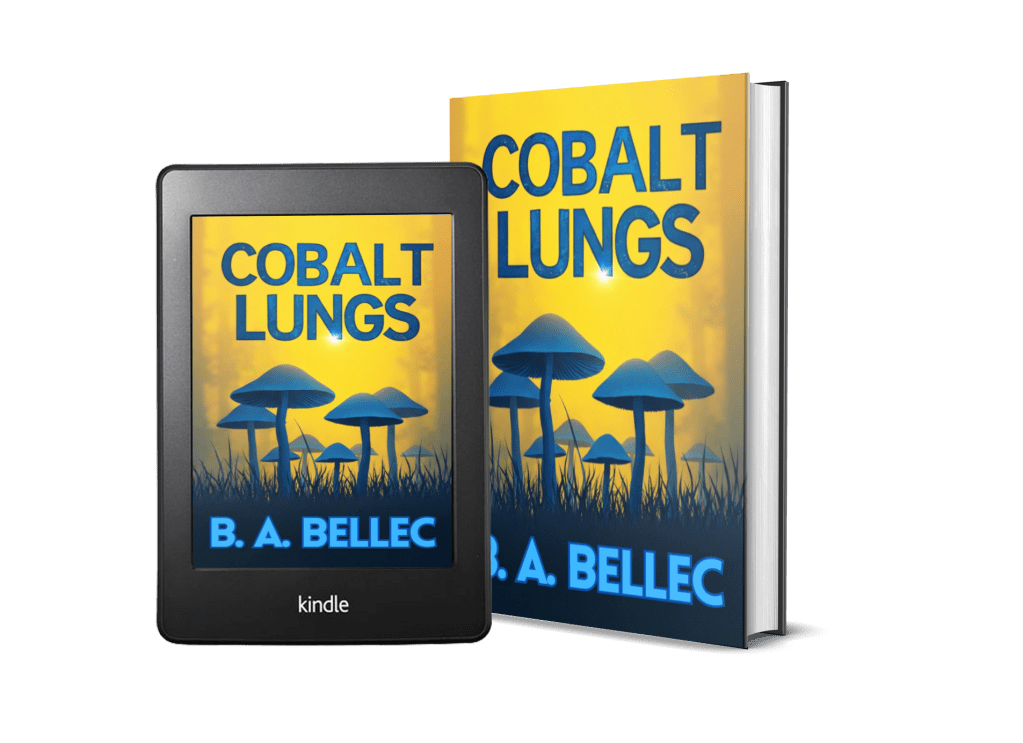
1. The Core Phenomenon: The Cobalt Mycelial Aerosol
At the center of Cobalt Lungs is a novel airborne environmental organism commonly referred to as cobalt lungs and cobalt spores.
The name is inaccurate.
Cobalt is not a gas.
Not smoke.
Not dust.
Not metal poisoning in the conventional sense.
It is a hybrid aerosolized fungal-mineral system. The cobalt nickname comes more from the color than function.
The organism exists as microscopic mycelial structures suspended within the atmosphere, combined with reactive cobalt-bearing mineral particulates and unknown catalytic binding agents. In open air, these structures form faint filament networks that drift through pressure gradients and low-flow environments.
The technical name of the spores is Beauveria caeruleus (B. caeruleus) which is Latin. Beauveria is a fungus and caeruleus means dark blue.
To the naked eye, severe exposure zones resemble:
- blue haze
- suspended filaments
- web-like atmospheric structures
- dense particulate clouds during storms
Inside the body, however, the organism behaves differently.
During autopsy, advanced victims show visible mycelial growth throughout lung tissue:
- branching fungal-like structures
- cobalt-stained respiratory pathways
- fibrous growth embedded deep within alveolar surfaces
Macroscopically, the lungs resemble invasive fungal colonization. This condition is named APF (Aerosporic Pulmonary Fibrosis) by doctors.
But under microscopy, the structures fracture into sharp mineralized microfilaments resembling asbestos shards.
This contradiction becomes central to the scientific confusion surrounding the outbreak.
The organism is simultaneously:
- biological
- particulate
- structural
- environmental
It does not behave like a traditional pathogen.
It behaves like an adaptive atmospheric ecosystem.
2. Airborne Behavior and Environmental Dynamics
Unlike conventional aerosols, cobalt does not disperse evenly through open air.
The particulate mycelial structures exhibit:
- cohesion
- directional clustering
- pressure sensitivity
- airflow responsiveness
- density layering
The result is an atmosphere that behaves inconsistently across space.
One area may remain breathable.
Another, meters away, may become lethal.
The haze gathers in:
- valleys
- enclosed spaces
- forests
- urban corridors
- stagnant airflow regions
Storm systems dramatically destabilize distribution.
High winds and pressure changes cause:
- violent redistribution events
- temporary atmospheric thinning
- sudden concentration spikes
- rolling particulate fronts
This creates the “haze waves” seen throughout the novel:
not a singular cloud,
but a constantly reorganizing environmental network.
The world itself becomes unstable to navigate.
Survival is no longer about avoiding infection entirely.
It becomes about:
- timing
- movement
- airflow
- exposure duration
- density thresholds
Breathing itself becomes situational.
3. Water Transmission and Post-Rain Spore Events
Beauveria caeruleus spores can also be transported through water. During rainfall, airborne spores become trapped inside raindrops as the water forms a thin membrane around the particulate. In certain atmospheric conditions, this creates the distinctive cobalt shimmer sometimes visible during storms, where rain appears faintly blue beneath artificial light or direct sunlight.
Although rainwater itself can contain spores, direct consumption is generally less dangerous than inhalation. Most ingested spores are destroyed by stomach acid instead of being embedded in lung tissue. As a result, significantly higher exposure levels are required for waterborne infection compared to airborne exposure. However, repeated consumption of untreated water can still lead to gradual accumulation and result in severe health conditions.
The greater danger occurs after rainfall.
As rain evaporates, the protective water membrane surrounding the spores disappears, leaving cobalt particulate distributed across streets, rooftops, vegetation, and other exposed surfaces. This creates what are informally known as “post-rain events,” periods of heightened environmental instability where simple movement can re-agitate dormant spores back into the air. Walking across contaminated pavement, vehicle movement, or even moderate wind conditions can trigger localized aerosolization. Strong winds following rainfall are considered especially hazardous due to the high concentration of disturbed particulate matter near ground level.
Because of this, water treatment became essential infrastructure during the collapse. Any untreated water source may contain suspended spores and therefore requires filtration before safe consumption. Smaller survivor communities often rely on improvised purification systems with limited effectiveness, while advanced settlements such as Sanctum utilize large-scale atmospheric and water filtration networks capable of producing stable potable water supplies. Ethan’s silo system represents a smaller-scale adaptation of similar filtration principles, providing sustainable water independence through layered purification and controlled storage systems.
4. Human Exposure and Pathophysiology
The primary route of exposure is inhalation.
Once inhaled, the mycelial particulate structures enter the respiratory tract and begin embedding within lung tissue.
The process occurs in stages.
Stage 1 — Initial Exposure
Particles bypass upper respiratory filtration and settle deep within alveolar tissue.
Symptoms:
- throat irritation
- subtle pressure changes while breathing
- delayed reaction timing
- mild hypoxia
- sensory instability
At this stage, much of the damage remains reversible.
Stage 2 — Integration
The organism begins physically anchoring into lung surfaces.
Microscopic filament growth spreads through respiratory tissue while cobalt-rich particulates mineralize around the structures.
This causes:
- reduced oxygen transfer
- inflammatory collapse
- tissue rigidity
- impaired gas exchange
Victims experience:
- coughing
- fatigue
- breathing resistance
- delayed motor response
- neurological fog
- hypoxia-induced cognitive impairment
The body increasingly spends energy simply maintaining respiration.
Stage 3 — Structural Failure
In severe exposure cases, the lungs begin catastrophic breakdown.
Fluid accumulation combines with fragmented mycelial particulate material, producing:
- aerated cobalt secretions (blue foam)
- oxygen starvation
- respiratory collapse
Some victims expel distinctive blue foam from the mouth during terminal failure.
Not all cases produce visible foam.
But when present, it indicates:
- widespread alveolar destruction
- surfactant collapse
- advanced particulate integration
The foam becomes one of the defining visual horrors of the outbreak.
Not because it is universal.
Because it is recognizable.
5. Sanctum vs Ethan: Two Philosophies of Survival
The central scientific conflict of Cobalt Lungs is philosophical.
Not technological.
Sanctum’s Approach — Environmental Control
Sanctum believes survival comes from controlling the environment itself.
Their systems focus on:
- massive filtration infrastructure
- pressure-controlled architecture
- compartmentalized airflow routing
- atmospheric stabilization
- exposure containment
Sanctum does not truly eliminate cobalt.
Instead, it:
- redirects it
- stabilizes it
- predicts its movement
- limits density accumulation
Their philosophy is simple:
Control the air, and you control survival.
This creates highly ordered environments that feel mechanically safe but psychologically oppressive.
Sanctum attempts to dominate nature through systems.
Ethan’s Approach — Adaptive Coexistence
Ethan initially believes the same thing.
His early work focuses entirely on elimination:
- perfect filtration
- particulate removal
- sterile airflow systems
But isolation blinds him.
The breakthrough only occurs after Maddy enters his life. (His breakthrough is a bit of a red herring. Right at the end of the story, he realizes the serum was probably ready for human trials much sooner, and his baggage with Sanctum kept him from proceeding)
Ethan eventually realizes the organism cannot be fully removed.
The problem is not exposure itself.
The problem is exposure rate.
His work shifts toward modulation rather than elimination.
Instead of designing systems that prevent all contact, Ethan develops methods that:
- slow integration
- delay embedding
- reduce clustering efficiency
- give the body time to adapt and clear particulate load
This becomes the true scientific breakthrough of the novel.
Not eradication.
Tolerance.
The body survives not because the world becomes clean again,
but because survival windows become possible.
6. Ethan’s Filtration Research
Inside the silo, Ethan develops micro-environmental airflow systems based on what he calls:
Density Gradient Filtration
Instead of filtering every particle equally, the system manipulates:
- airflow resistance
- particulate velocity
- density distribution
- clustering behavior
This produces localized “slow zones” where cobalt movement becomes less aggressive.
Effects include:
- delayed particulate embedding
- slower mycelial integration
- extended breathable windows
- improved survival duration
Importantly:
Ethan is not creating clean air.
He is engineering time.
This distinction becomes the conceptual backbone of the novel.
7. The Serum (ARES Prototype)
ARES is an acronym. It stands for Airborne Response and Exposure Suppression, which was the name when Sanctum started the serum project, but the brass at Sanctum liked that ARES would look good on the marketing, so they almost only refer to the serum as ARES, but it is more of a general term for all of Ethan’s work at Sanctum, not just the serum.
Ethan’s eventual breakthrough shifts from environmental engineering to biological intervention because it was always his path. The environmental engineering was out of necessity, but he always felt the real project was to also create an intervention point human could administer and control, rather than trying to control everything.
The serum is not a cure.
It is a temporary adaptive treatment.
Its purpose is to alter the interaction between:
- lungs
- cobalt structures
- the body’s immune response
Core Functional Components
1. Surface Stabilization Layer
A biochemical coating temporarily binds to alveolar tissue.
This:
- reduces direct filament anchoring
- slows structural embedding
- protects vulnerable respiratory surfaces
2. Particulate Modulator
The treatment alters how cobalt clusters behave inside the lungs.
Instead of fine embedding structures, particles aggregate into larger masses.
Larger clusters are:
- less invasive
- easier to expel
- slower to integrate
The body can cough them out before deep colonization occurs.
3. Immune Threshold Support
The serum does not “kill” the organism.
Instead, it gives the body enough time to respond before catastrophic integration occurs.
This is the key revelation:
human survival depends on surviving with exposure long enough for biological adaptation and medical intervention to occur.
8. Mice Trials and Experimental Results
Ethan validates the serum using accelerated rodent exposure models.
The white mice are intentionally exposed to cobalt concentrations roughly ten times higher than normal human environmental exposure.
This allows Ethan to:
- compress timelines
- observe integration behavior rapidly
- identify toxicity thresholds
- test protection windows
Results evolve throughout the novel:
| Trial Phase | Survival Duration |
| Untreated | Rapid failure |
| Early Serum | ~2 days |
| Stabilized Formula | ~2.5 days |
| Final Breakthrough | ~3 days |
At equivalent human scaling, this represents:
- several hours of meaningful protection
- potentially longer in lower-density environments
That window becomes enough to:
- travel through contaminated zones
- conduct rescues
- survive storms
- rebuild infrastructure
- create future research possibilities
- Transport people to medical treatment facilities
The science never becomes magical.
The world remains dangerous.
The breakthrough simply makes survival possible again.
The entire breakthrough is also a bit of a red herring; the 2.5-day version probably would have worked on human trials, but the bad exit at Sanctum delayed him from wanting to take the next steps. Part of the ending to the story is that it turns out Ethan had basically gone a little crazy alone in the silo and was chasing something he didn’t need to, and probably could have been taken to market way sooner had he been working with a bigger team or had been able to get over his Sanctum incident sooner.
9. The Haze Events
The “blue haze” is not merely weather.
It represents large-scale atmospheric reorganization of cobalt density systems.
As the organism spreads globally, the atmosphere itself becomes increasingly unstable.
The haze behaves almost ecologically:
- responding to airflow
- reorganizing after disruption
- settling into environmental structures
- forming temporary equilibrium states
Late-stage storms become existential events because they collapse stable distribution zones.
During these events:
- breathable regions disappear suddenly
- visibility fractures
- cobalt density spikes catastrophically
- filtration systems overload
- the events can be very slow moving (like a fog/haze)
Entire populations can suffocate within hours if caught exposed.
The haze is terrifying precisely because it is not alive in a traditional sense.
It has no intent.
Only behavior.
10. Thematic Integration of the Science
The science of Cobalt Lungs is inseparable from its emotional themes.
Control vs Adaptation
Sanctum seeks absolute control.
Ethan learns survival requires adaptation.
Maddy embodies acceptance:
the ability to remain emotionally human inside an uncontrollable world.
Breath as Identity
Breathing becomes:
- mechanical
- emotional
- psychological
- relational
Characters constantly negotiate:
- panic vs calm
- control vs surrender
- isolation vs connection
The act of breathing becomes symbolic of living itself.
Time as the True Resource
The science never truly defeats the organism.
Instead, it creates:
- delays
- windows
- chances
- moments long enough for connection
The entire novel ultimately revolves around a single scientific and emotional principle:
Survival is not permanence.
Survival is time made meaningful.
Summary
The science of Cobalt Lungs is built around a hybrid airborne mycelial-particulate organism that transforms the atmosphere into an unstable environmental system.
Through:
- airflow manipulation
- adaptive filtration
- biochemical modulation
- environmental observation
- and controlled exposure management
humanity slowly discovers that the world cannot be purified back into safety.
But it may still be survivable.
Not through dominance.
Through adaptation.
Through endurance.
Through learning how to breathe inside a world that no longer guarantees breath.
 B.A. Bellec